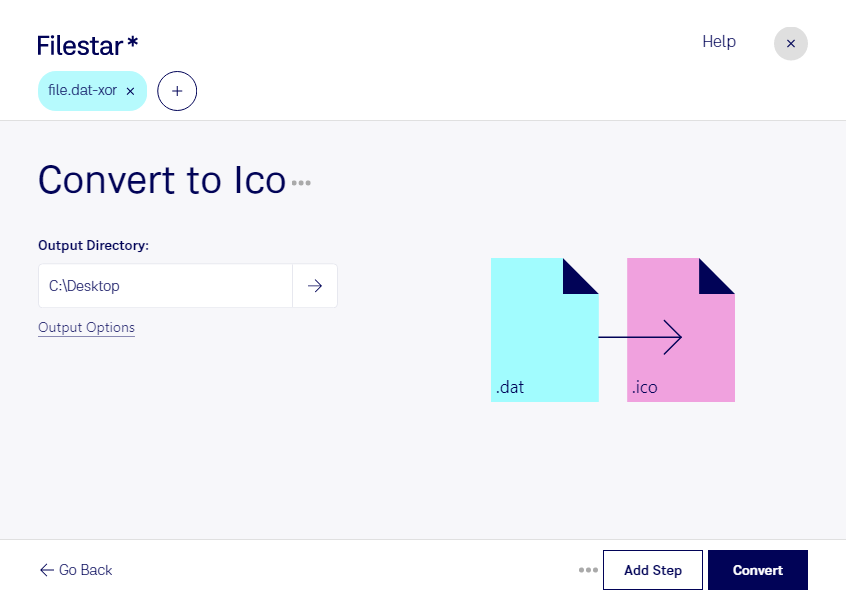
Download and install the latest version of Filestar.
Right click on one or more Dat file(s) on your desktop and select Convert with Filestar.
Type convert to ico in the search box.
Press Convert.
Or let an AI agent do it: filestarcli -i file.dat -c "convert to ico" (how).
Let your AI agent convert XOR Encrypted File to ICO
Claude Code, Codex, Cursor and other agents can do this on your computer with Filestar. Your files stay on your machine.
Install Filestar and add it to your agents:
npm install -g filestar
filestarcli agent install
Then ask your agent:
“Convert the XOR Encrypted File files in my Downloads folder to ICO”
Or run it yourself:
filestarcli -i file.dat -c "convert to ico"
Runs on your computer, so your files stay on it. Works on Windows, macOS and Linux. 50 free conversions with the npm install, no account needed.
Can my AI agent convert XOR Encrypted File to ICO?
Yes. Install the Filestar CLI with npm install -g filestar and your agent can run filestarcli -i file.dat -c "convert to ico" on your computer, so your files stay on it.
A .dat file whose contents are encrypted with a simple XOR key. WeChat stores the images from its chats this way, and some other apps do the same with sound and documents. Filestar finds the key and restores the original file, such as a JPEG, PNG or GIF.
An ICO file is an image format used to store icons for Windows programs, files, and folders. It contains two bitmaps: 1) the AND bitmap - the image mask (which determines what part of the icon is transparent) and 2) the XOR bitmap - contains the icon which is mapped onto the image mask. ICO files can be modified to create custom icons.