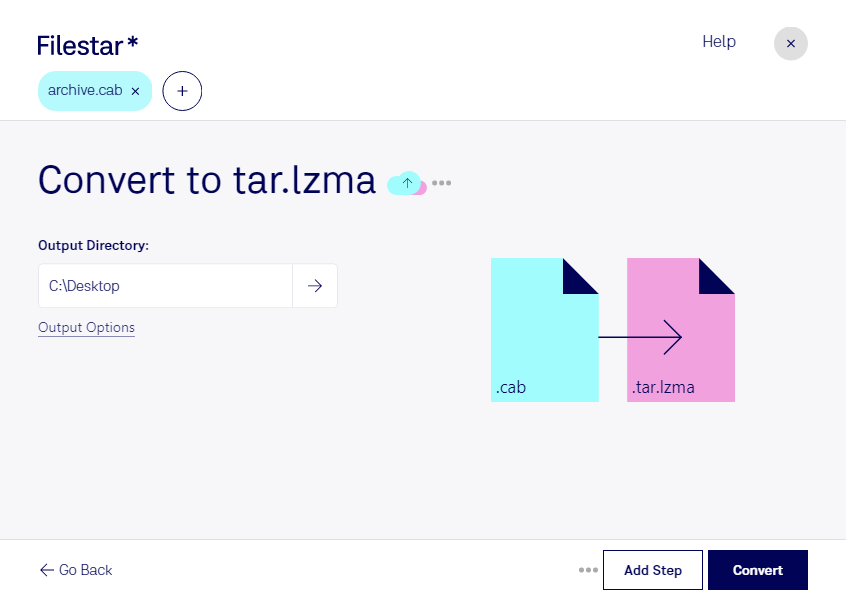
Convert cab to tar.lzma

  1. Download and install the latest version of Filestar.

  2. Right click on one or more Cab file(s) on your desktop and select Convert with Filestar.

  3. Type convert to tar.lzma in the search box.

  4. Press Convert.

Or let an AI agent do it: filestarcli -i file.cab -c "convert to tar.lzma" (how).

convert cab to tar.lzma

Let your AI agent convert CAB to TAR.LZMA

Claude Code, Codex, Cursor and other agents can do this with Filestar. This skill runs in Filestar's cloud and needs a paid Filestar plan.

Install Filestar and add it to your agents:

npm install -g filestar
filestarcli agent install

Then ask your agent:

“Convert the CAB files in my Downloads folder to TAR.LZMA”

Or run it yourself:

filestarcli -i file.cab -c "convert to tar.lzma"

Runs in Filestar's cloud and needs a Filestar plan.

Can my AI agent convert CAB to TAR.LZMA?

Yes, with a paid Filestar plan: this skill runs in Filestar's cloud. Install the Filestar CLI with npm install -g filestar and your agent can run filestarcli -i file.cab -c "convert to tar.lzma".

Using Filestar With AI Agents · Download SKILL.md

What is the difference between .cab and .tar.lzma?

Extension
.cab
.tar.lzma
Format
Binary
Binary
Category
Developer
Compressed
Developer
Microsoft
7-Zip
Description
A CAB file is a Windows Cabinet file saved in an archive format native to Microsoft Windows that supports .ZIP, Quantum, and LZX data compression algorithms. CAB files contain compressed data and is used for Windows software installations such as system files, network components, and device drivers.
"Tarball" (.TAR file) compressed with .LZMA (Lempel-Ziv-Markov chain Algorithm) compression, and thus uses the compound file extension ".tar.lzma;" often used for distributing linux software packages.
MIME Type
application/vnd.ms-cab-compressed
application/x-lzma-compressed-tar

Convert Cab To Tar.lzma Today

Get started within minutes