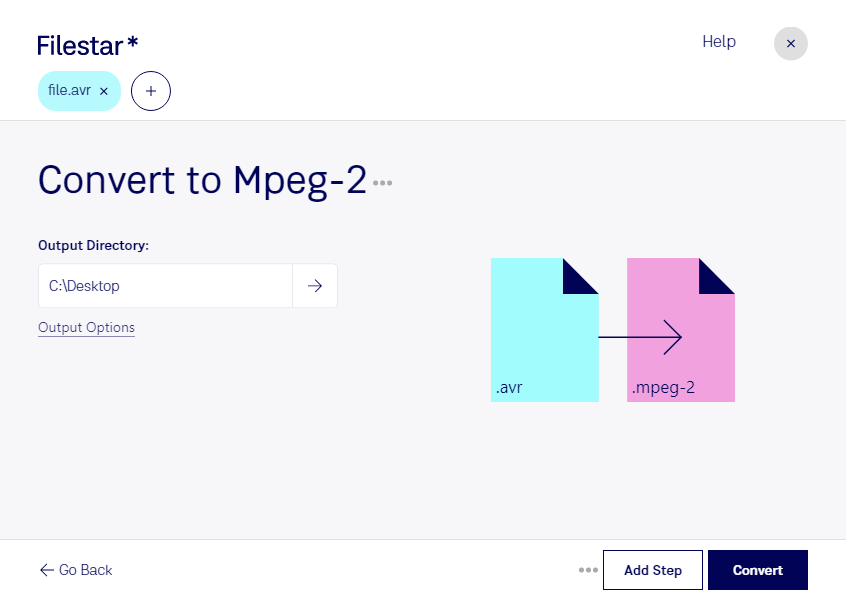
Download and install the latest version of Filestar.
Right click on one or more Avr file(s) on your desktop and select Convert with Filestar.
Type convert to mpeg-2 in the search box.
Press Convert.
Or let an AI agent do it: filestarcli -i file.avr -c "convert to mpeg-2" (how).
Let your AI agent convert AVR to MPEG-2
Claude Code, Codex, Cursor and other agents can do this on your computer with Filestar. Your files stay on your machine.
Install Filestar and add it to your agents:
npm install -g filestar
filestarcli agent install
Then ask your agent:
“Convert the AVR files in my Downloads folder to MPEG-2”
Or run it yourself:
filestarcli -i file.avr -c "convert to mpeg-2"
Runs on your computer, so your files stay on it. Works on Windows, macOS and Linux. 50 free conversions with the npm install, no account needed.
Can my AI agent convert AVR to MPEG-2?
Yes. Install the Filestar CLI with npm install -g filestar and your agent can run filestarcli -i file.avr -c "convert to mpeg-2" on your computer, so your files stay on it.
The AVR (Audio Visual Research) file format is a proprietary audio format developed by Audio Visual Research for use on Macintosh computers. It was primarily used in older Mac operating systems and is less common today. AVR files were designed for storing digitized audio data, often used in conjunction with early audio editing and processing software on the Mac platform. This format allowed for the storage and manipulation of various types of audio information, making it a useful tool for researchers, musicians, and audio engineers during its time of popularity.
Video file encoded with the MPEG-2 codec, which is mainly used for over-the-air, satellite, and cable digital TV signals and DVD video; uses lossy compression for audio and video to significantly reduce the size of the video data; not as efficient as the H.264 format.