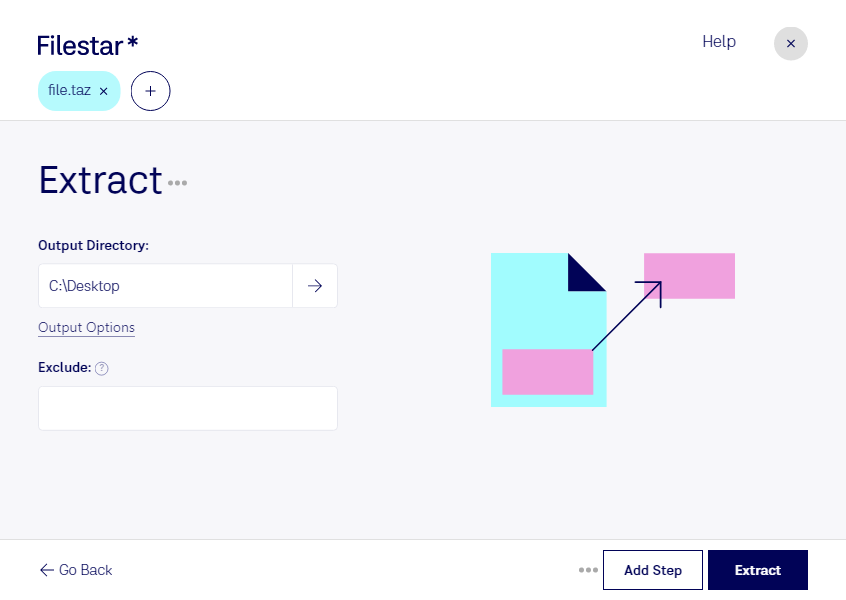
Lade die neueste Version von Filestar herunter und installiere sie.
Klicke auf deinem Desktop mit der rechten Maustaste auf eine oder mehrere Taz-Dateien und wähle Convert with Filestar.
Gib extract in das Suchfeld ein.
Klicke auf Extract.
Or let an AI agent do it: filestarcli -i file.taz -c "extract" (how).
Let your AI agent TAZ entpacken
Claude Code, Codex, Cursor and other agents can do this on your computer with Filestar. Your files stay on your machine.
Install Filestar and add it to your agents:
npm install -g filestar
filestarcli agent install
Then ask your agent:
“Use Filestar to TAZ entpacken in my Downloads folder”
Or run it yourself:
filestarcli -i file.taz -c "extract"
Runs on your computer, so your files stay on it. Works on Windows, macOS and Linux. 50 free conversions with the npm install, no account needed.
Can my AI agent TAZ entpacken?
Yes. Install the Filestar CLI with npm install -g filestar and your agent can run filestarcli -i file.taz -c "extract" on your computer, so your files stay on it.
Eine TAZ-Datei ist im Wesentlichen ein komprimiertes Archiv, das mit dem Unix-basierten Archivierungsprogramm Tar erstellt und anschließend mit dem Programm compress komprimiert wurde. Der Teil „tar“ im Dateinamen steht für „tape archive“, also „Bandarchiv“, und verweist auf die ursprüngliche Verwendung des Programms zur Datensicherung auf Bandlaufwerken. Das „z“ zeigt an, dass das Archiv mit dem Lempel-Ziv-Algorithmus (LZ) komprimiert wurde, um seine Größe zu reduzieren.