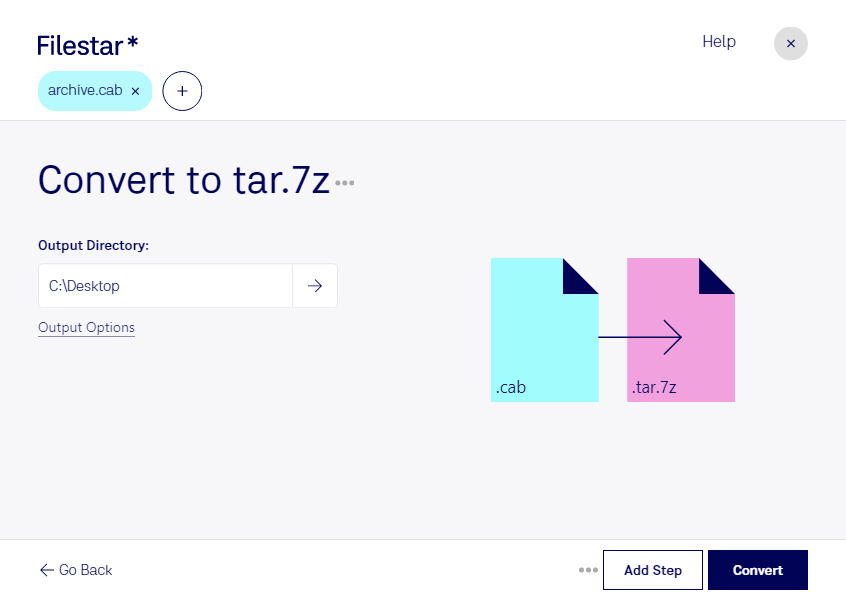
Download and install the latest version of Filestar.
Right click on one or more Cab file(s) on your desktop and select Convert with Filestar.
Type convert to tar.7z in the search box.
Press Convert.
Or let an AI agent do it: filestarcli -i file.cab -c "convert to tar.7z" (how).
Let your AI agent convert CAB to TAR.7Z
Claude Code, Codex, Cursor and other agents can do this on your computer with Filestar. Your files stay on your machine.
Install Filestar and add it to your agents:
npm install -g filestar
filestarcli agent install
Then ask your agent:
“Convert the CAB files in my Downloads folder to TAR.7Z”
Or run it yourself:
filestarcli -i file.cab -c "convert to tar.7z"
Runs on your computer, so your files stay on it. Works on Windows, macOS and Linux. 50 free conversions with the npm install, no account needed.
Can my AI agent convert CAB to TAR.7Z?
Yes. Install the Filestar CLI with npm install -g filestar and your agent can run filestarcli -i file.cab -c "convert to tar.7z" on your computer, so your files stay on it.
A CAB file is a Windows Cabinet file saved in an archive format native to Microsoft Windows that supports .ZIP, Quantum, and LZX data compression algorithms. CAB files contain compressed data and is used for Windows software installations such as system files, network components, and device drivers.
This format works based on the LZMA principle compression algorithm. It was originally used in 7-Zip archives. tar.7z archives were created for storing info about file owners and for ease of use in Unix systems, based on a TAR archiving tool.